echoes
Fragments in Minor Keys
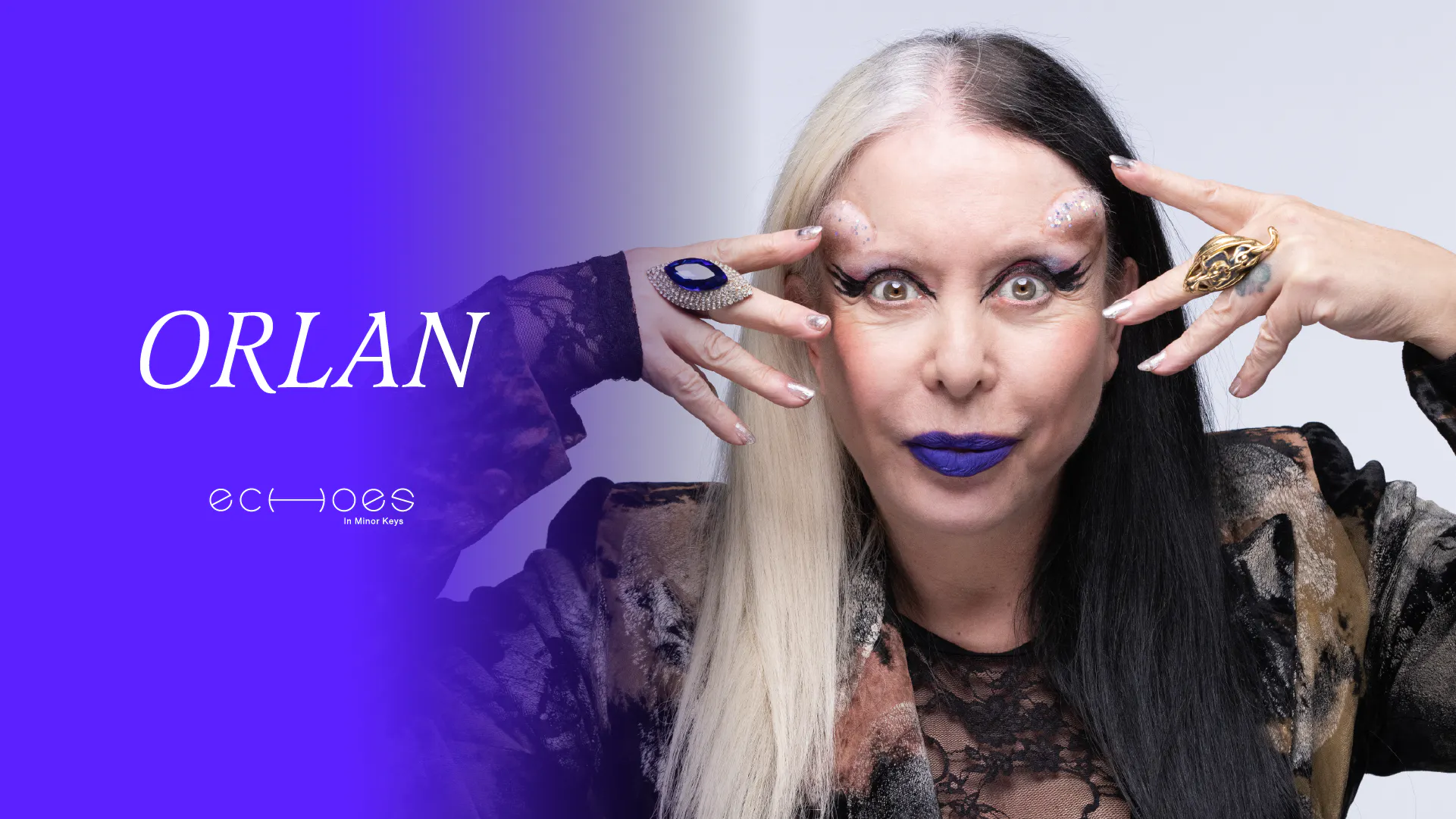
ORLAN —
On Inconsolability, Rage, and Artistic Responsibility
ORLAN — A conversation with Francesca Carol Rolla
Venice, 2026
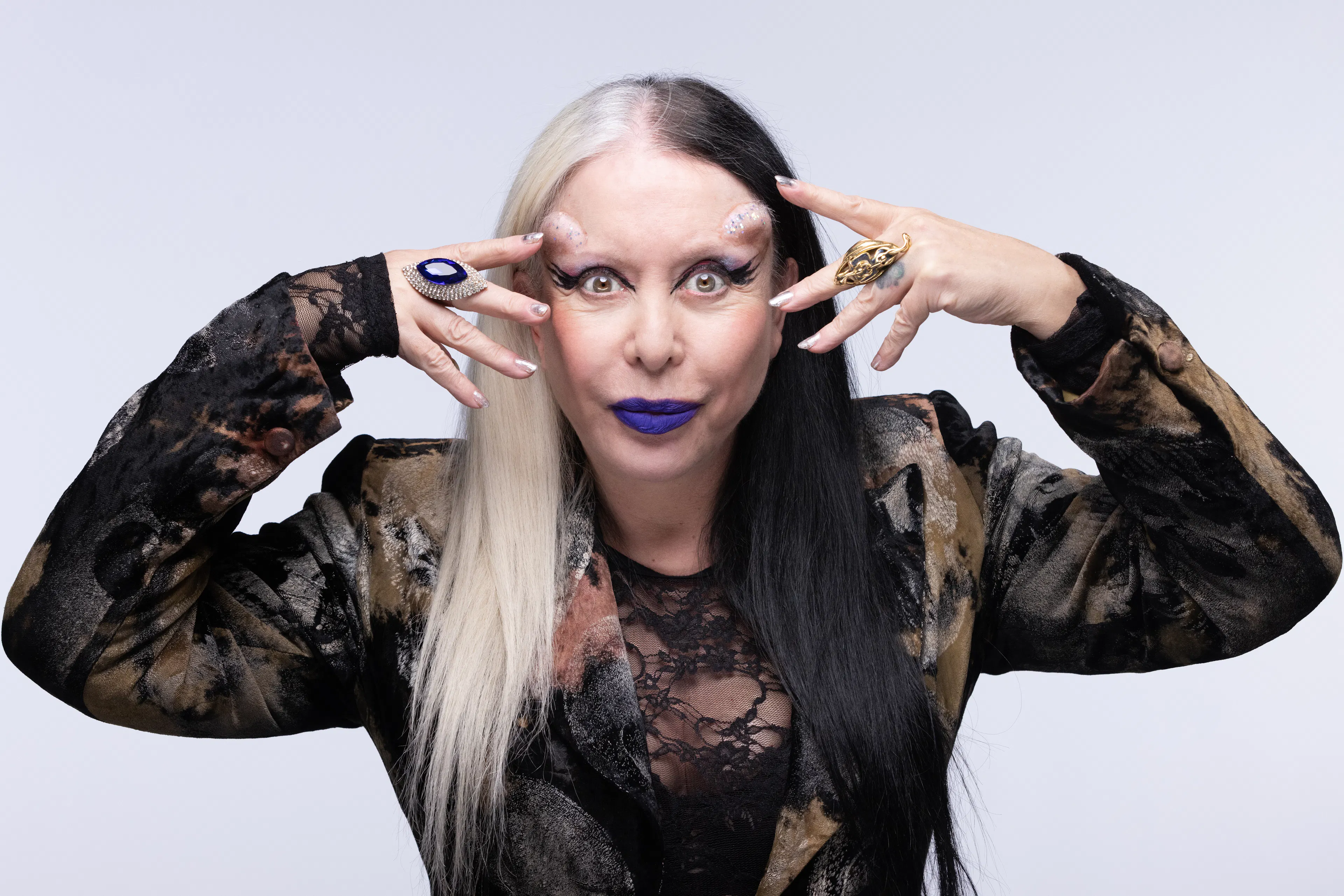
Photo credits © Joel Saget/AFP
For more than five decades, ORLAN has moved across performance, photography, sculpture, biotechnology, robotics, artificial intelligence, and digital media to interrogate the social, political, technological, and symbolic conditions of her time. Anticipating new languages, tools, and imaginaries, her practice has consistently challenged the conventions through which we understand the body, identity, and representation.
Presented during the 2026 Venice Biennale, Nous Sommes Inconsolables (We Are Inconsolable), ORLAN’s latest series, curated by Francesca Carol Rolla, emerges from a profound sense of urgency.
In this conversation, ORLAN reflects on the body as a political site, on inconsolability as both a personal and collective condition, on the responsibility of artists in a time marked by social regression, and on the risks and possibilities opened by technological change. At the heart of the conversation is an invitation not to turn away from the questions of our time, but to engage with them through attentiveness, critical awareness, and responsibility.
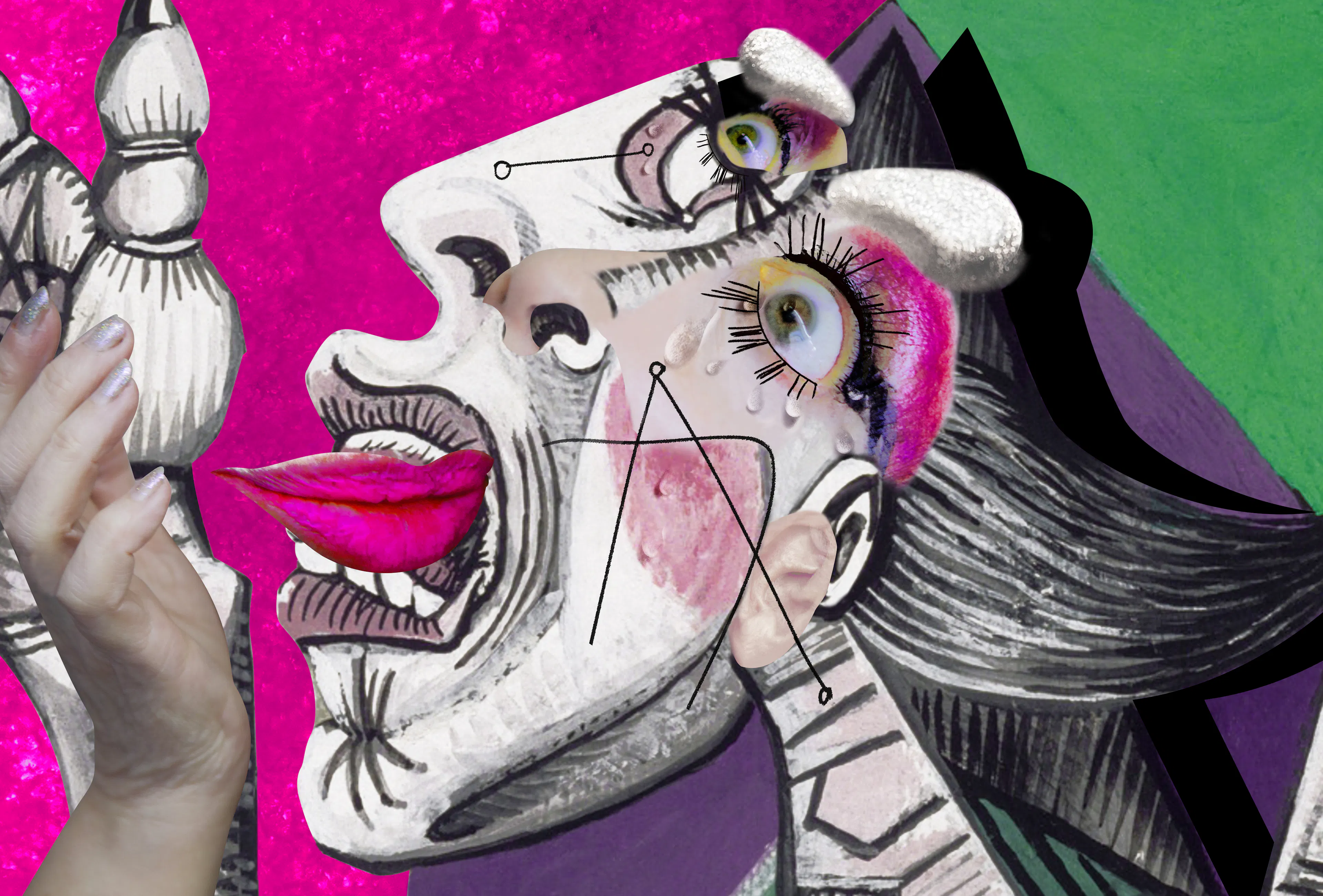
Self-hybridation entre femmes, acte 2 : Les femmes qui pleurent sont en colère no 4 , 158 × 110 cm, 2019 © ORLAN STUDIO, Courtesy ORLAN STUDIO and Ceysson & Bénétière
Francesca Carol Rolla: Madame ORLAN, your work has never allowed itself to be confined to a single medium, technology, or mode of expression. Instead, it seems to be driven by an ongoing engagement with the present. What does it mean to be an artist of one's time today?
ORLAN: I have never wanted to be confined to a specific artistic practice, technology, or material. What matters to me is addressing the social phenomena and positioning myself within them. Sometimes I use photography, sometimes video, sculpture, biotechnology, AI, robotics, or technologies that do not yet exist and that I may discover tomorrow.
The medium is never where the work begins. It always begins with a question.
When I feel that I have truly engaged with a contemporary social phenomenon, I know I have established the backbone of a work — its concept and its manifesto. From there, each artwork becomes a body growing from that backbone.
FCR: Throughout your practice, the body appears less as a stable identity than as a site of transformation, contradiction, and political struggle. What does the body allow us to understand that language alone cannot?
ORLAN: The body is political. The personal is political. What we do, and what we do not do, is political.
We believe we have a body, but in reality, we have many bodies. We are shaped by those who came before us, by culture, by language, by technologies, by histories, by ideas we often carry without even realizing it.
My work has always attempted to reveal those forces.
I fabricate bodies because the body remains the place where power, identity, desire, memory, and transformation become legible.
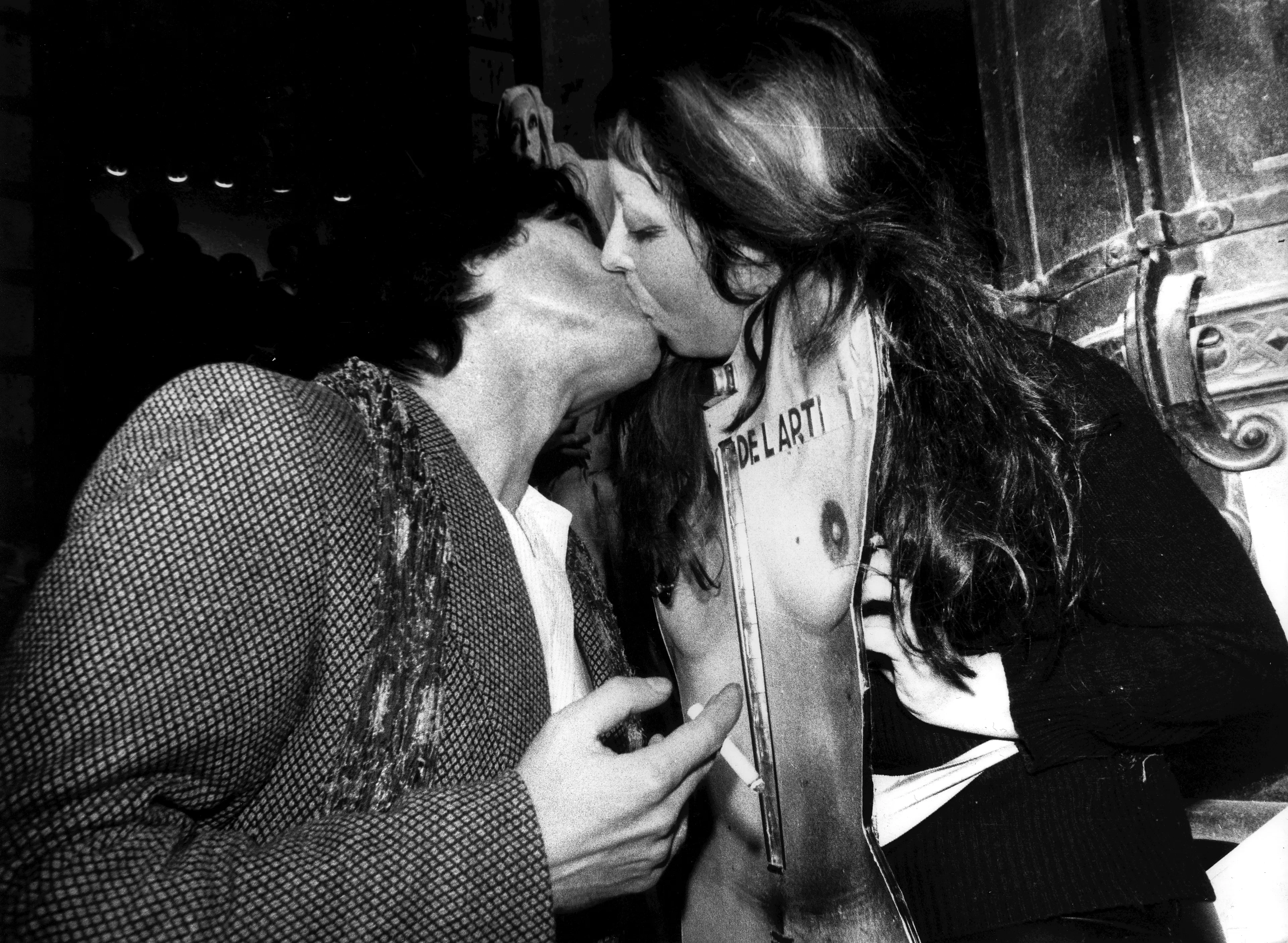
Le Baiser de l’Artiste, photo-performance, 40 x 33 cm, 1977 © ORLAN STUDIO, Courtesy ORLAN STUDIO and Ceysson & Bénétière
FCR: The title of your recent series, Nous Sommes Inconsolables, feels both intimate and collective. What does it mean to be inconsolable today?
ORLAN: I am truly inconsolable about what is happening in the world.
I belong to a generation that believed things would improve, step by step. We believed society would become more conscious, more mature. We believed in progress.
I grew up with the values of the Enlightenment. I thought that racism would disappear. I thought that women would achieve equality. I thought that humanity would learn from its mistakes.
Instead, we are witnessing forms of regression that I never imagined I would see again.
That is why I felt compelled to say it publicly, loudly, and clearly.
I am inconsolable.
And I understood that this had become my mission: to transform that inconsolability into work.
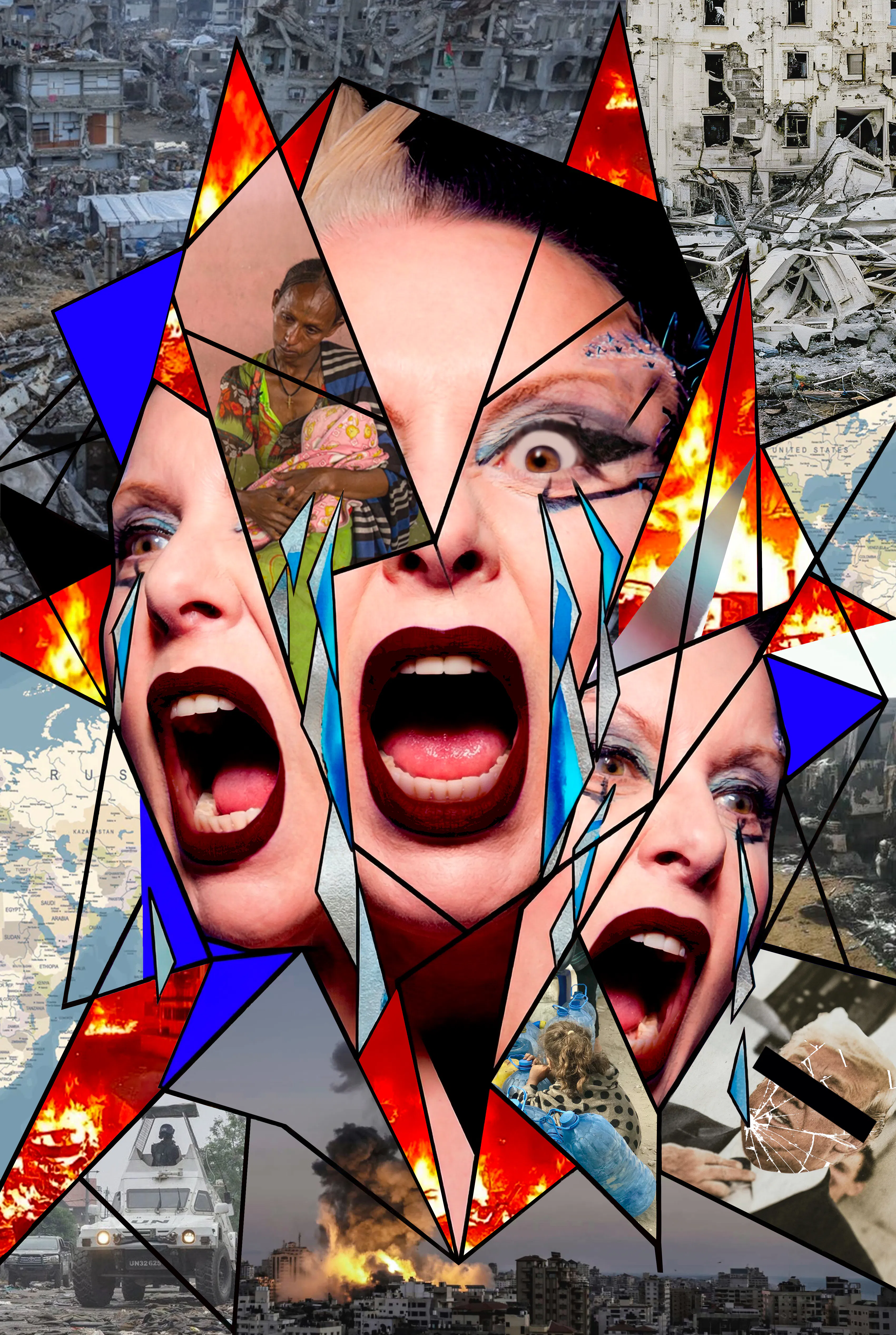
Nous sommes inconsolables, Feu, guerre et douleur, 123 x 181.8 x 3 cm, 2026 © ORLAN STUDIO, Courtesy ORLAN STUDIO and Ceysson & Bénétière
FCR: In these works, tears seem as important as the scream. What do they represent for you today?
ORLAN: There are experiences for which language proves inadequate. Tears and screams emerge from that threshold.
The tears in these works are not tears of resignation. They are political tears. They carry grief, anger, disappointment, and refusal all at once.
I am inconsolable because I see forms of violence, intolerance, and regression that I never imagined I would witness again.
And then there is the scream. Of course, there was Munch's scream. Now there is my scream.
I scream. I cry. I howl.
Enough is enough.
The scream is not merely an expression of despair. It is also an act of resistance. A refusal to remain silent in the face of violence, misogyny, war, obscurantism, injustice and indifference.
For me, tears and screams are signs that we are still alive, still capable of feeling, still capable of responding. The day we stop crying and stop screaming is the day we begin to accept what should never be accepted.
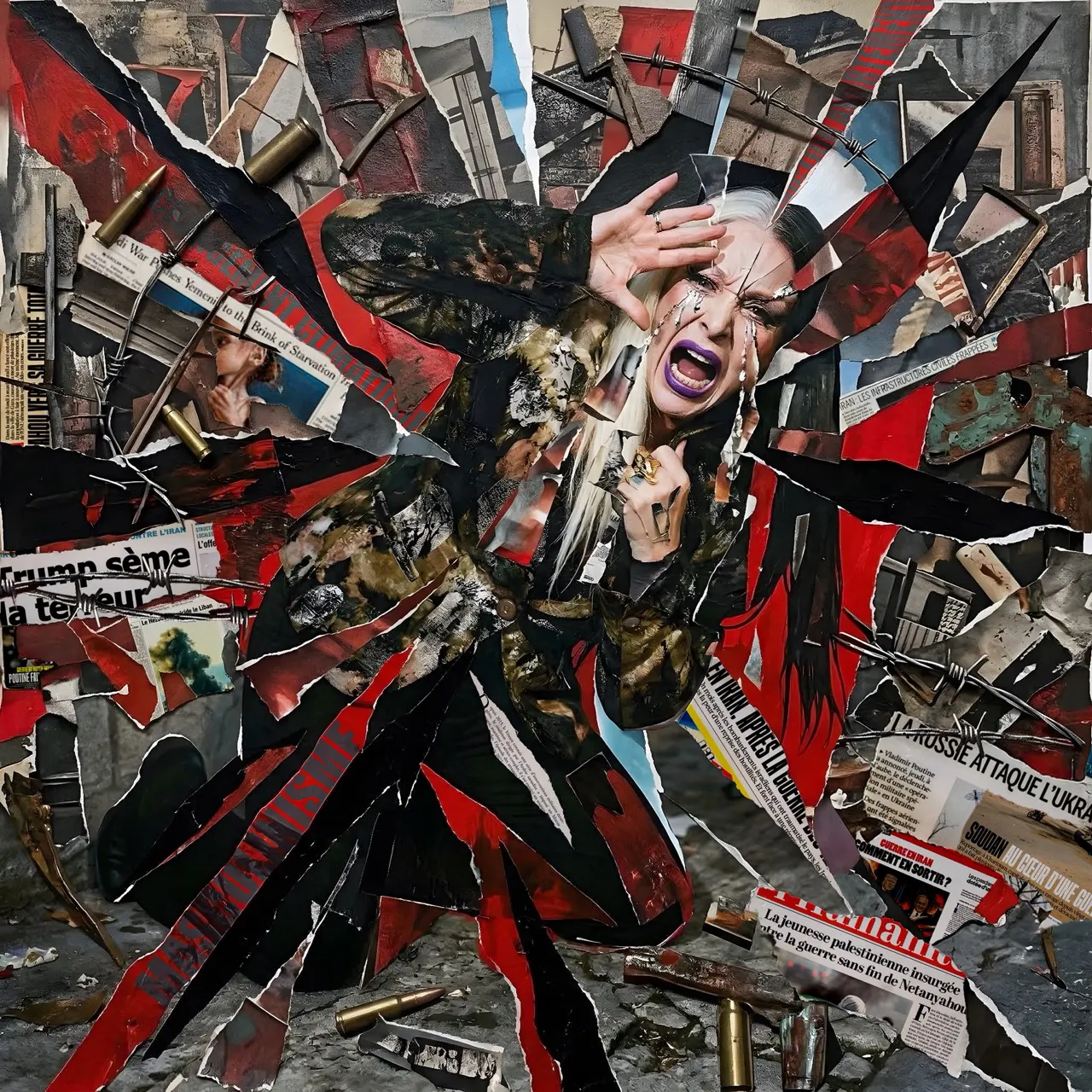
Nous sommes inconsolables, Manifeste contre les horreurs de notre époque, 143 x 143 x 3 cm, 2026 © ORLAN STUDIO, Courtesy ORLAN STUDIO and Ceysson & Bénétière
FCR: Your work has always insisted that art cannot be separated from the conditions of its time. What responsibilities do artists have when confronted with war, social regression, and the normalization of violence?
ORLAN: An enormous responsibility.
Artists cannot simply look at their own reflection, seek personal satisfaction, decorate interiors, or produce beautiful objects disconnected from reality.
We cannot do without a consciousness of the world and of the time we are living through.
Today, bringing people together around a work of art carries responsibility.
To ignore the suffering unfolding around us would be a terrible form of indifference.
Artists must remain on the side of sensitivity, reflection, and care.
We must be the counterweight.
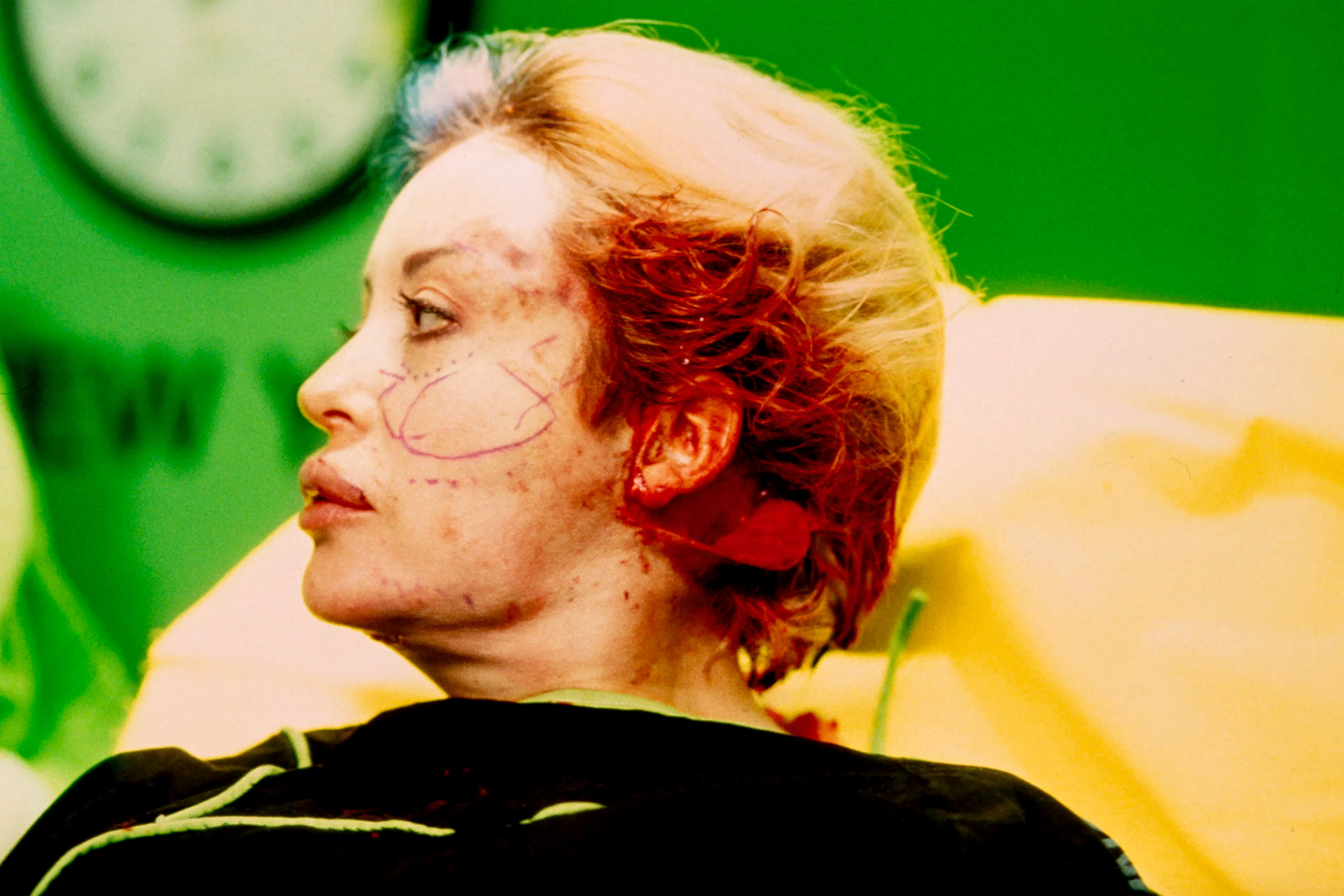
La Réincarnation de Sainte-ORLAN ou images nouvelles-images / 7ème Opération-chirurgicale-performance dite Omniprésence, Sourire de plaisir en voyant son corps ouvert sans en souffrir, 21 novembre 1993, New York, 110 × 165 cm, © ORLAN STUDIO, Courtesy ORLAN STUDIO and Ceysson & Bénétière
FCR: You have engaged with emerging technologies for decades, long before artificial intelligence entered public consciousness in its current form. Why do you prefer to speak of “auxiliary intelligence” rather than “artificial intelligence”?
ORLAN: Because I believe we need it.
Human beings alone do not possess enough memory or enough capacity to confront the complexity of the present. We need auxiliary forms of memory and intelligence.
That is why I prefer the term “auxiliary intelligence.” It is not a substitute for human thought. It is something that can accompany and extend it.
I do not fear technology. I fear human beings.
Technology is a tool. Like a hammer, it can be used to build or to destroy.
What matters is who designs it, who controls it, and what values are embedded within it.
That is why we must remain vigilant.
The question is never the machine. The question is always the human being behind it.
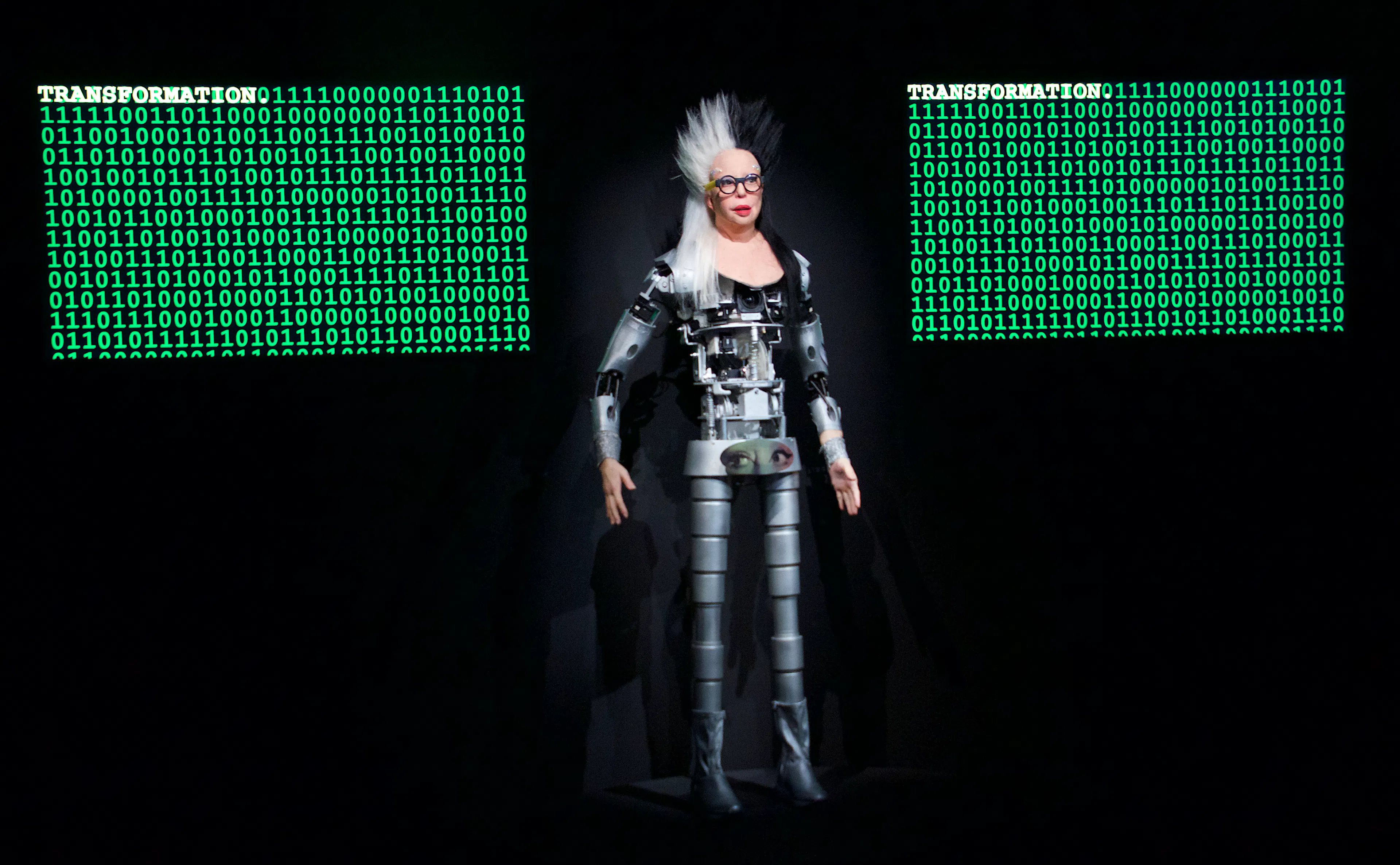
ORLANoïde. Strip-tease artistique électronique et verbal, robotic installation and video, 2018 © ORLAN STUDIO, Courtesy ORLAN STUDIO and Ceysson & Bénétière
FCR: In Nous Sommes Inconsolables, painting and artificial intelligence are not presented as opposites. Nor are visibility and invisibility, tradition and innovation. Instead, they seem to coexist within the same image. Why was it important for you to bring these different registers together?
ORLAN: For me, artificial intelligence is not a substitute for art. It is another material, another tool, another way of thinking through images.
What interests me is the encounter between painting and new technologies, between the hand and the machine, between memory and innovation.
In this series, I was also thinking about Robert Filliou and his principle of equivalence: well made, badly made, not made. I have always found that principle extraordinarily liberating.
In these works, painting is sometimes visible, sometimes almost invisible, sometimes completely absent, and sometimes only represented. What interests me is not certainty, but the space of uncertainty that opens between these different states.
I want viewers to look carefully and ask themselves what they are actually seeing.
Today, we live surrounded by manipulated images, distorted narratives, and an endless flow of AI-generated imagery. This is why it is essential to cultivate a critical gaze.
More than ever, we must learn to question images rather than simply consume them.
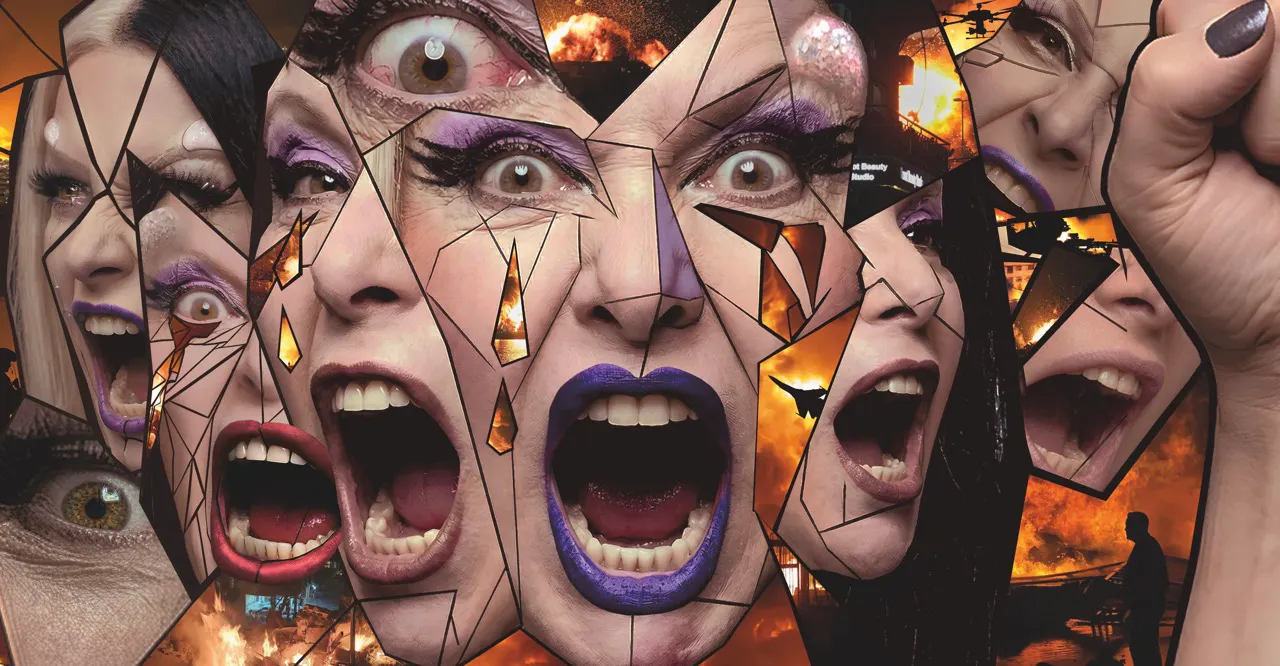
Nous sommes inconsolables, Notre besoin de consolation est impossible à rassasier, 250 x 130 x 3 cm, 2026 © ORLAN STUDIO, Courtesy ORLAN STUDIO and Ceysson & Bénétière
FCR: Throughout this conversation, you have returned again and again to the idea of coexistence rather than opposition: painting and artificial intelligence, body and technology, memory and invention. What might we learn from holding together things we have been taught to think of as separate?
ORLAN: There are no new images without art history. There are no new images without museums.
“The muses and the history of art are the stem cells of new images,” Nietzsche used to say.
We have art so that we do not die from the truth.
What we call new images are often very old images returning through new tools, new technologies, and new forms of perception. If we abandon memory, we lose the ability to understand what we are creating.
For me, the challenge has never been to choose between past and future, tradition and innovation, the hand and the machine.
The challenge is to hybridise them.
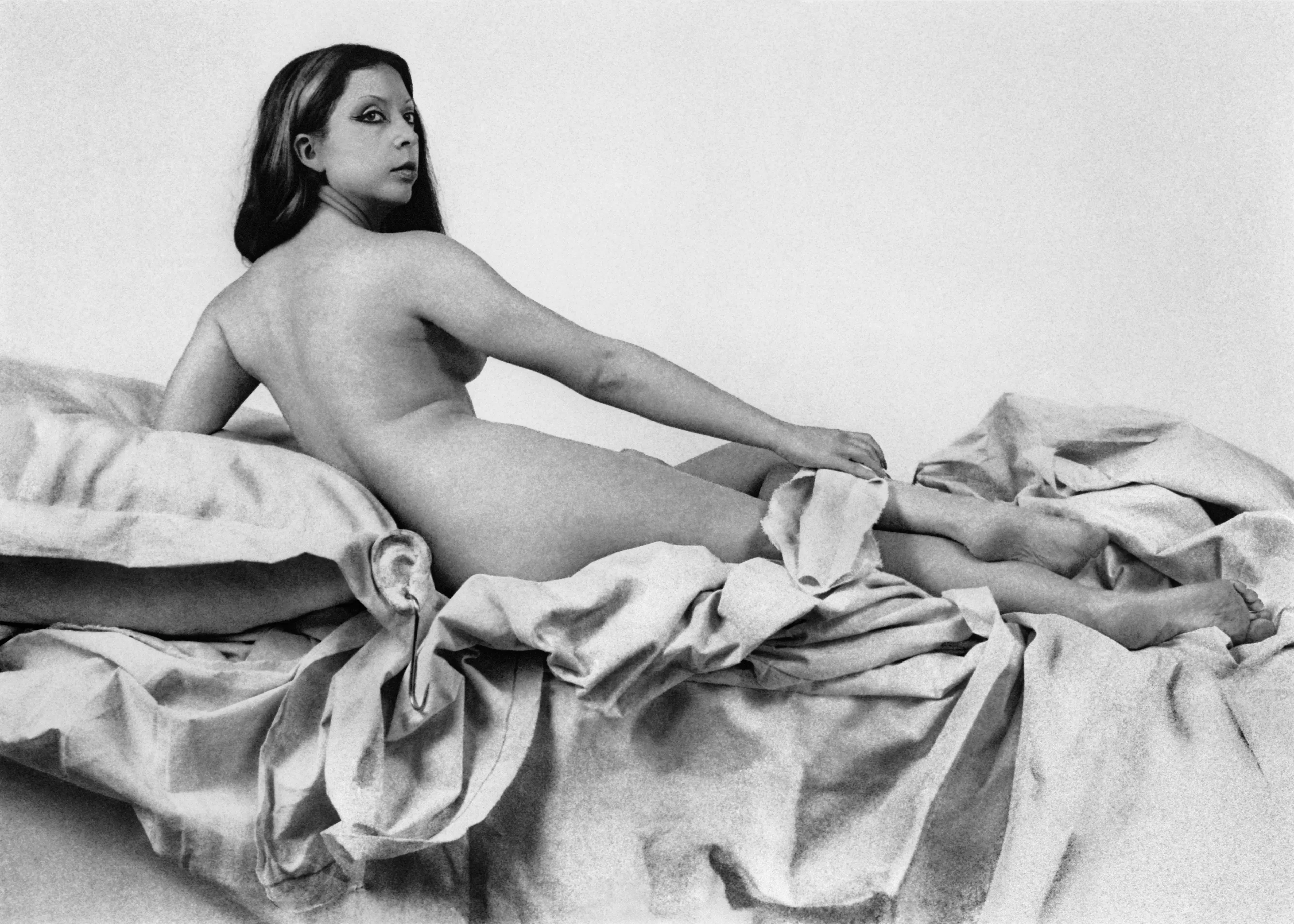
Tableaux vivants situation-citation, ORLAN en Grande Odalisque d’Ingres, 150 x 210 cm, 1976-1977 © ORLAN STUDIO, Courtesy ORLAN STUDIO and Ceysson & Bénétière
I have always been fascinated by the lessons of the Baroque. Bernini teaches us something essential: we do not have to choose between good or evil. We must learn to inhabit the space between them. For too long, we have been taught to think through oppositions: true or false, body or technology, nature or culture, past or future.
Baroque art teaches us another possibility.
It teaches us to replace the "or" with the "and."
And perhaps today, in a world increasingly tempted by simplification, certainty, and division, that lesson has become more necessary than ever.
ORLAN is a French artist, writer, and pioneering figure in performance, body, and media art. Working across performance, photography, sculpture, video, robotics, AI, biotechnology, and digital technologies, her practice challenges social, political, religious, and cultural forms of domination, with a particular focus on the body, identity, and the conditions through which cultural norms are inscribed upon individuals.
Her work is held in the collections of the Museum of Modern Art, New York; Centre Pompidou, Paris; Getty Museum, Los Angeles; LACMA, Los Angeles; The Andy Warhol Museum, Pittsburgh; Fondation Pinault, Paris; Museum Kunstpalast, Düsseldorf; The National Museum of Art, Osaka; Sungkok Art Museum, Seoul, and numerous other public and private collections worldwide.
ORLAN has been awarded the French National Order of Merit, the Order of Arts and Letters, and the Legion of Honour. Her work "Le Baiser de l’Artiste" is included among the Centre Pompidou’s 100 Masterpieces of the Twentieth Century.
echoes is a curatorial project conceived within We Exhibit and curated by Francesca Carol Rolla. It brings into relation art, culture, and memory through encounters and practices of listening, where voices from contemporary art, critical thought, and research intersect.
Learn more about the project on the dedicated page of our EDITORIALS edition.